









Was SegWit a compromise with big blockers?
No.
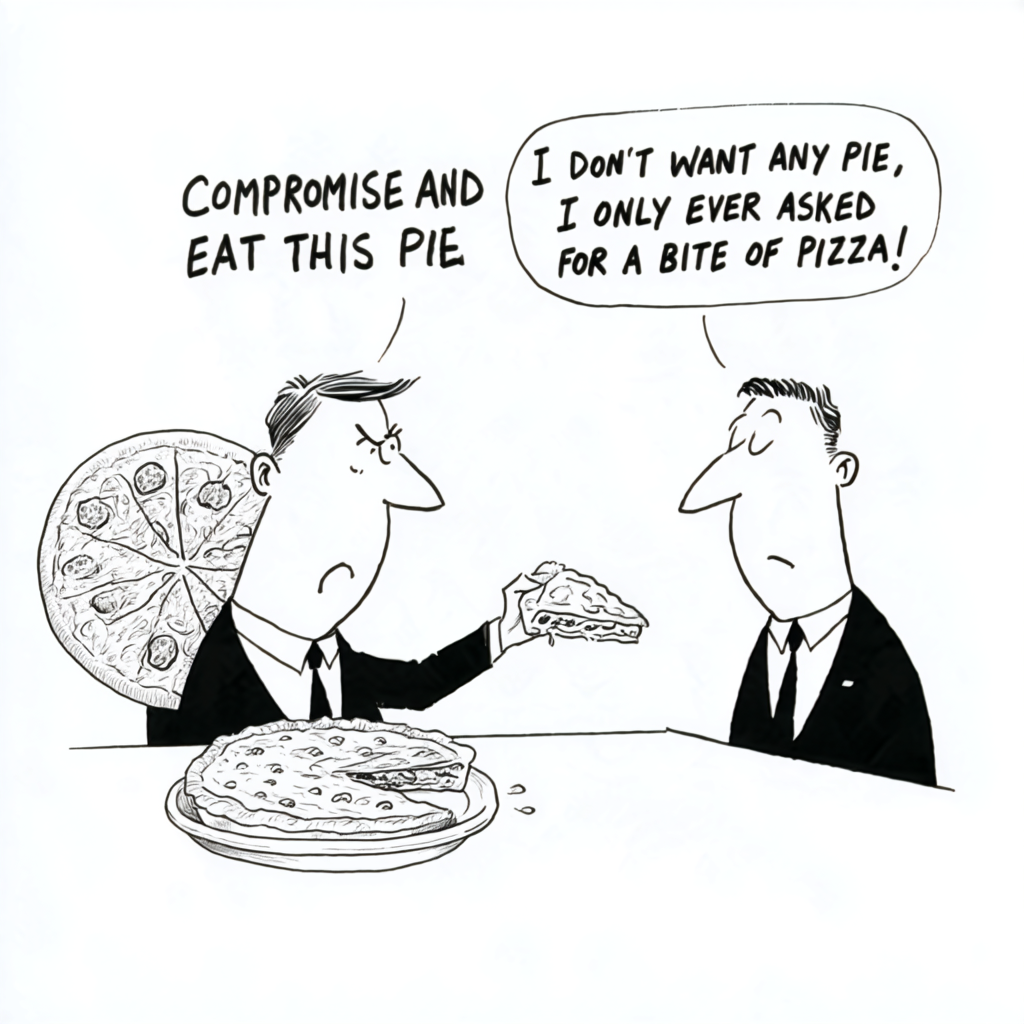
Ignoring a counterparty's desires is no compromise, only a potentially self-righteous justification of "I tried to be fair" in the mind of the bad-faith offering party.
A compromise is when each side of a conflict is offered something they want, but no big blockers ever wanted SegWit of their own volition. This is self-evident in the fact that BCH does not have SegWit, because it was such a point of contention that it was worth chain-splitting to avoid. Big blockers objected to SegWit entirely, on the basis that it was a break in the fundamental chain of signatures, and a poor way to implement increased capacity. The other benefit of SegWit, the fix to transaction malleability, was also implemented on BCH without SegWit. Small blockers wanted SegWit, so its inclusion was a compromise from big blockers to small blockers (if anything), rather than the reverse.
SegWit can only be considered "a compromise" to big blockers to the extent that perhaps small blockers independently felt they were offerring something big blockers wanted, but no big blockers actually agreed with that & all protestations were met with deaf ears. The block weight change of SegWit is NOT a blocksize increase & demanding it be accepted as equivalent is either ignorant or bad-faith. It's not a compromise to tell someone they should accept the small half of the pie when they're trying to tell you they don't want ANY pie, they want a slice of pizza.
The retelling that SegWit was a "compromise" is a way for small blockers to frame themselves as the "reasonable" party willing to compromise in hindsight, even though the historical record does not support that (see below).
This piece of common propaganda:
- Contradicts false claims that SegWit was implemented with consensus.
- Relies on the related propaganda that SegWit is a blocksize increase. That is also highly misleading, if not an outright lie, one of many contributing to the sentiment that negotiation was proceeding in bad faith.
The truth is that many more attempts were made to compromise from the big-blocker side, but negotiations finally collapsed once enough people in the big block camp realised Bitcoin was being hijacked and endless unproductive negotiations was playing into the hands of bad-faith actors.
Historical timeline
Consider this history:
-
May 2015: Gavin Andresen & Mike Hearn suggest a Bitcoin blocksize increase to 20MB. Source
-
July 2015: Gavin Andresen suggests BIP101, an immediate increase to 8MB with doubling every two years afterwards until 2036. Source
-
August 2015: Adam Back famously suggests an immediate 2MB increase with a 4 and then 8MB blocksize increase to follow. Source
-
February 2016: The Hong Kong agreement proposes a SegWit activation with an expected 2 to 4MB blocksize increase to follow. Source
-
May 2017 - The New York Agreement again agrees to an even further reduced SegWit activation with a 2MB blocksize increase to follow within six months. Source
-
August 2017 - Amaury Séchet is convinced bad-faith acting is rife in the debate and takes action with several others to preserve SegWit-free Bitcoin. Bitcoin chainsplits, BCH gains bigger blocks, SegWit activates on the small block side.
-
November 2017 - SegWit2X does not activate as promised in the NYA agreement. Many small blockers celebrate having achieved their goal of SegWit without needing to deliver any concessions.
It is plain to see how the starting big block position of 20MB blocks was negotiated away (effective compromises by the big block side), bit by bit with NO movement from the existing 1MB small blocker size until, in the end, no blocksize increase remained! All that was left is the SegWit implementation, which (as explained above) no big blockers ever wanted!
In the end, SegWit was activated but the 2MB follow up was never delivered. And thus, not only was SegWit itself never a compromise, but the best chance at an actual compromise was gleefully sabotaged & celebrated by many of the same people who will today pretend SegWit was a compromise.